

Custom Tuck Boxes That Assemble in Seconds

The Case for a Tuck Box
A tuck box is a folding carton whose lids close by tucking a flap into the box body rather than being glued shut. That single design choice makes tuck boxes fast to assemble by hand, easy to open and reclose, and inexpensive to produce, which is why they dominate retail shelves for cosmetics, supplements, and small consumer goods.
There are two common variants. A straight tuck end (STE) opens from the same side top and bottom for a clean front face. A reverse tuck end (RTE) opens from opposite sides, using less board and lowering cost. We help you pick the variant that balances appearance against material efficiency for your product.
Straight vs. Reverse Tuck
| Feature | Straight tuck (STE) | Reverse tuck (RTE) | |
|---|---|---|---|
| Tuck direction | Same side, top and bottom | Opposite sides | |
| Front face | Cleanest — no flap edges | Slight flap edge visible | |
| Material use | Slightly more board | More economical | |
| Best for | Premium retail look | Cost-sensitive runs |
Tuck Box Specifications
- Material
- SBS or kraft cardstock, 14-24 pt
- Styles
- Straight tuck end, reverse tuck end
- Add-ons
- Hang holes, tear strips, die-cut windows
- Printing
- Offset and digital; PMS spot colors
- Finishing
- Matte, gloss, soft-touch, spot UV, foil
- Pilot quantity
- From 100 units
Small Details That Improve a Tuck Box
Tuck boxes accept useful structural features. A friction-lock or tuck-lock tab keeps the lid closed in transit; a hang hole lets the box merchandise on a peg; a die-cut window shows the product inside. We add these to the dieline where they help, and check that print stays clear of tuck and glue zones so nothing smears at assembly.
Fast Pack-Out at Scale
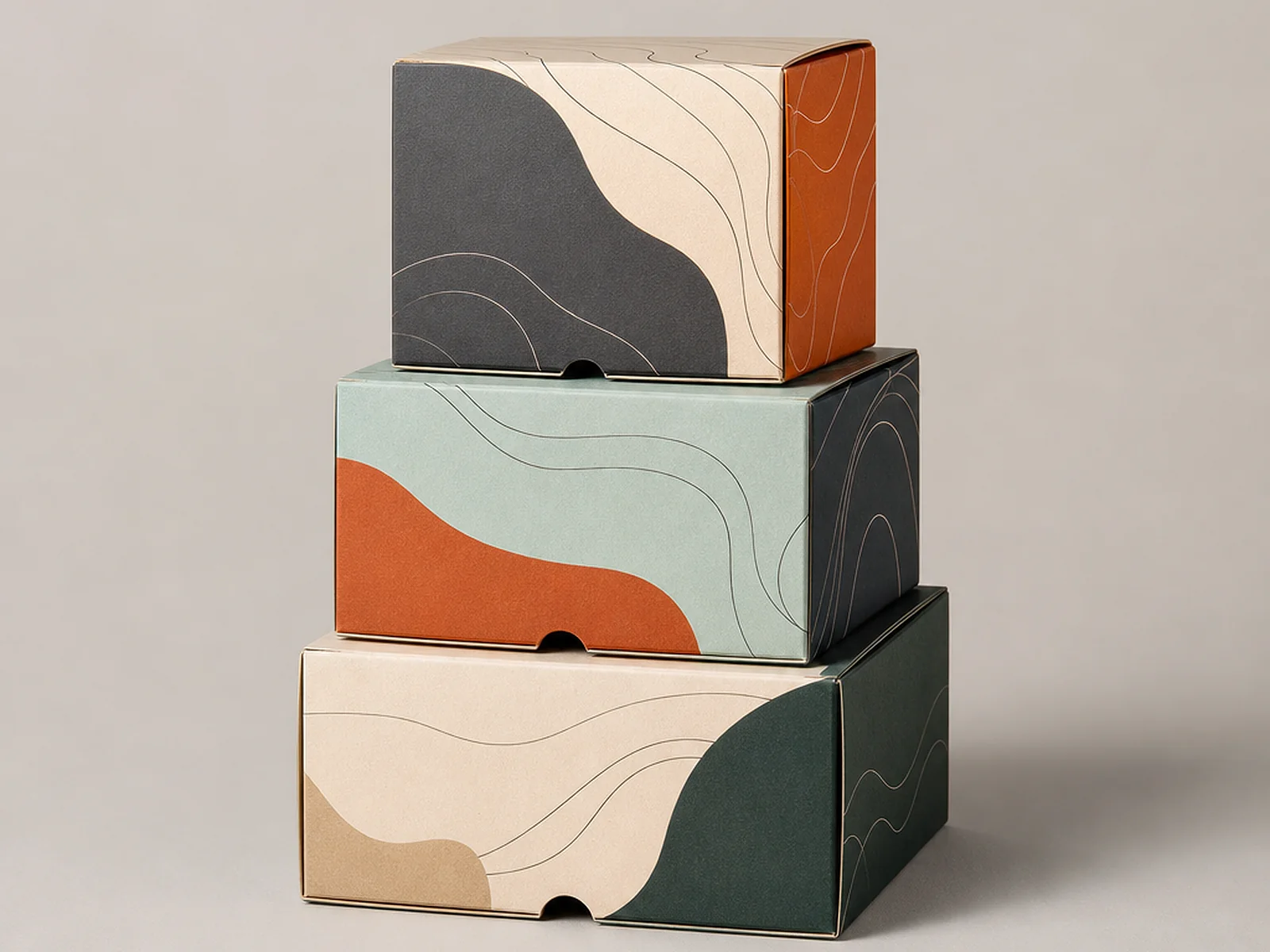
The reason tuck boxes are everywhere is speed at pack-out: with no glue needed to close the box, a worker can erect and fill one in seconds. That efficiency compounds across a large fulfillment run. We keep print clear of tuck and glue zones so nothing smears at assembly, and add friction- or tuck-lock tabs so the lid stays closed in transit. Digital printing keeps a first pilot run affordable, and the same dieline scales to an offset volume run as demand grows.
Getting the Tuck to Seat Right
A tuck box lives or dies on how its closure behaves. If the tuck flap is cut a hair too long it buckles when it enters the slot; too short and the lid pops open in a bag or on a shelf. We size the flap, the slit-lock, and the friction of the tuck to the caliper of your board so the box snaps shut with a satisfying seat and stays closed through handling — without needing glue or tape at pack-out.
Straight-tuck-end (STE) and reverse-tuck-end (RTE) look similar but differ in how the top and bottom flaps face. STE keeps both openings on the same side, which hides the seam behind the front panel and photographs cleanly for retail; RTE alternates the flaps, which is slightly more material-efficient and speeds hand assembly. If your team packs by hand, RTE is usually faster; if the front face is a hero panel on a shelf, STE presents better. Tell us how the box will be filled and displayed and we will pick the closure that fits your workflow.